

Don't Burn Your Tastebuds
By Liv Wedderburn, Head of Influence


Taste is a giant lint brush - a sticky scroll through which the world rolls you - and for every stray hair of bland nothingness, there’s a grain of glitter with no clear origin.
Who knows what it was that stuck to my developing frontal lobe to make me the way I am?
There are some quite obvious through lines: my media diet is, and has always been, whatever the Criterion Closet equivalent is for 90s Romcoms and High School Dramas. From the tame (Wild Child) to the disturbed (Jawbreaker), I hold a flame as the patron saint of teenage angst. Most of my world view and fashion sense can be boiled down to a VHS tape (age jumpscare) of Romy and Michelle’s High School Reunion, recorded on a VCR.
A spell of not good Mental Health™️at college saw me either staying up until 4 in the morning watching Greg Araki and Todd Solondz movies, or out trying to recreate Parker Posey’s life in Party Girl - the first half, though thankfully, I did become a born again librarian á la Parker, consuming just as much baba ganoush in the process. Access to content I shouldn’t have consumed at formative ages made me who I am today.
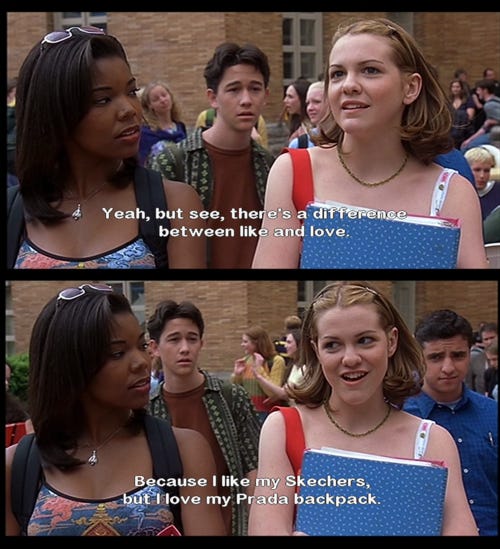
I never did catch Twilight, but thanks to 10 Things I Hate About You, I knew I wanted a Prada Backpack from the age of 7. Twenty years later, I had saved up enough to buy one.
It didn’t stop with movie madness. Hours playing The Sims: Hot Date lay the foundations for the comfort I find in red pleather booths in bars or luxuriating in hot tubs.
Friday nights in the late 90’s were often marked by my Mum fresh off the train from central, taking us to the home of weekends: TGIFridays to be precise. Whose to say whether this is why I own a Tiffany lampshade and love to pound Martinis as an adult?
What I can say though, is this: until very, very recently, I always felt entirely in control of my taste, both in what I sought out and what came to me. The two intertwined, as all interests deepened. The band got me to the festival, the festival got me to my new obsessions.
I always felt lucky I had a strong sense of self, and whilst any images from my school years will testify that I wasn’t immune to trying on every trend for size and to an extreme (yellow skinny jeans, backcombed hair, a lot of face metal), I felt like a very active participant in researching my interests, established or co-opted.
I knew the trap algorithms were luring me into. Being so in the Matrix that I’ve spent a decade working in Social meant I felt pretty clued up on what was following me around the internet, predestined to become my taste, versus what I had found knew to be true to myself.
But the other day I sat scrolling through my Spotify, sick of listening to the same 10 artists for the last 3 months, and had a haunting realisation I’d stopped actively searching for things. I had the intrusive thought that Spotify should be doing a better job surfacing up my new favourite band, by virtue of the fact I had spent 15 years stuffing it with personal data about myself. Why did I want to outsource the very intrigue and interests that have made me who I am today? Why did I level that personal responsibility of art and creativity on a machine?
And because Spotify knows me so well, as if by magic a new AI feature arrived. “Meet My New Favourite Artist” - a cheerful playlist artwork on the homage page baiting me in. Curious, I clicked. Against my better judgement allowed it to create me a ‘deep dive of an artist you haven’t explored yet’.
I acquiesced. And I balked. 30 seconds of listening to my on paper perfect match and I was revolted. Maybe part of it was my horrific stubbornness, wanting to prove the evil robots wrong. But was this really what fifteen years of loyal listening had boiled down to? Well, the data had found a pattern and suggested: yes! But data points aren’t emotions, no matter how much we try to make them feel like they are to make our jobs easier.
“I contain multitudes!” I regularly joke as if to contextualise the idiosyncrasies of my interests. But this is the least unique or interesting thing about me, or anyone. We all contain multitudes, but I worry that this is becoming a past tense idea. An idea from the before. I found myself grappling with a real life mortality and morality test, me against the end of my taste. I realised I used to take personal pride in identifying new things, and here I was upset that I wasn’t being served them right.
By definition, an AI or an Algorithm does not have taste. It has not experienced anything first hand. And its context is only what has happened before, not what’s happening now or in the future. No matter how hard it tries, it cannot convincingly tell you what to do like say or see in any parallel with the growth you experience as a real life human. The machines’ power and wealth comes from trying to make people as predictable as humanly possible to help obscure that painstakingly gaping creativity gap. There is no algorithm for culture, so flatlining taste and making it easier to predict is the most profitable path for platforms benefiting from mass AI adoption. The person who used to seek has become the person who waits to be shown, and that’s exactly where they want you.
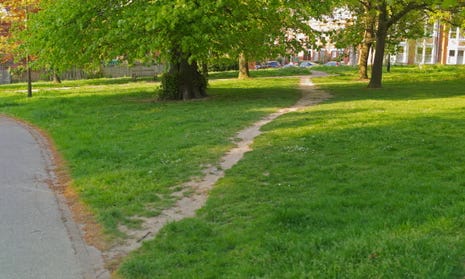
But the path that has been planned isn’t the one we always take. Humans have an opportunity to pave their own desire paths - to cut across the grass and take the route that fills them with the most joy.
In Good Will Hunting, Robin Williams prepared us for this flatlining and the fallacy of approximated taste. “If I asked you about art you’d probably give me the skinny on every art book ever written. Michelangelo? You know a lot about him. But I’ll bet you can’t tell me what it smells like in the Sistine Chapel.”
Whilst this 1997 Oscar Winner was upholding the value of lived experience vs the cock-sure attitudes of smug college students, the premise stays the same: you can sit and wait for your lines of code to get you so good its unearthed your new favourite film, or you can take the risk of sitting in the cinema seat and waiting til the credits role to find out if it moved you. The risk has always been the reward. But somewhere along the way we decided that art should be consumed, rather than felt.
When art loses that spark, when it becomes content that’s optimised and served rather than stumbled into and experiences, it’s not just the loss of a few cool and independent experiences. It’s the thread that has connected human beings to something bigger than themselves through every era, through every crisis and every turn of history. Taste isn’t just what makes us happy, it’s what makes us human. Erode the means by which that’s formed, and you’re taking away something innate in all of us.
The other clever thing about cultural homogeneity packaged as a solution is that it makes an enemy out of individuality. It tars “taste” as an expensive project - only for those who can wear them mad lil horse hoof shoes. But taste, in its personal and political execution, is an attention issue. And my plea is to pay attention to it: what are you willing to sit with, what are you willing to let in, what are you willing to seek?
John Waters once said “have faith in your own bad taste” - words we should all live by. Your ‘bad’ taste probably tells the world a lot more about you than your ‘good’ taste, because this is the heart of who you really are: the source material of your soul. These are the idiosyncrasies, the anomalistic data points on the demographic graph pinned up about you somewhere in the back end of our large language model. Holding onto these weird little spikes and keeping them intact is the best thing you can do for your preservation of being.
There are a lot of hot new takes coming down the track. Wait for them to cool off before consuming them.
Your tastebuds are there for you. Don’t burn them off to be more palatable to others.
 | A guest post by
|